
ORIGINALLY PUBLISHED ON APRIL 14, 1994
By Steve Newton
If there’s a rock ’n’ roll heaven, you know they’ve got a helluva band…and I like to think that there are at least three guitarists in the lineup: Stevie Ray Vaughan, Jimi Hendrix, and Randy Rhoads.
And when I picture Vaughan, I see him doing his famous toe-to-toe, heel-to-heel shuffle over to the edge of a cloud and gazing down with a particularly proud smile, because he’s spotted David Gogo, his former protégé.
The 25-year-old whiz kid from Nanaimo is now setting out on his own recording career, and he’s carrying the blues-rock torch as high as he can lift it. Before the tragic helicopter crash that took Vaughan to that great gig in the sky on August 27, 1990, his personal influence on the young string-bender was immeasurable.
“He came along at the right time,” says Gogo, calling from a Thunder Bay pay phone. “When I was 15 years old and digging the same music I’m digging now, there was no kinda contemporary guitar hero. People were either dead or old or whatever. And then Texas Flood came out, and I freaked! I was tellin’ all my buddies, ‘This guy’s right up there with Hendrix.’
“Shortly afterwards I got to meet him, and every time he came up to Vancouver we’d hang out, which was very nice. Apparently there’s some new book on Stevie some woman in Austin wrote, and there’s a little part in the book—I haven’t seen it yet, but a buddy of mine in Ottawa tells me—where it goes: ‘Stevie realized he was starting to make it on an international level when he played in Victoria, B.C., and a 15-year-old kid showed up dressed like him.’ And of course that was me, so that’s kind of cool.”
Rock-star deaths are a fairly common occurrence, but few have occurred under such tragic circumstances as Vaughan’s. The 36-year-old blues master had recently pulled himself out of a near-fatal cocaine addiction, and his career—thanks to the fine In Step release—was back on track. He’d just finished jamming with the likes of Eric Clapton, Robert Cray, and Buddy Guy when the helicopter he was flying in crashed into a fog-shrouded hillside near southeastern Wisconsin’s Alpine Valley Ski Resort.
Like a lot of folks, Gogo vividly recalls the sad moment when he heard the shocking news.
“My little sister phoned me,” he says, “and you know it’s not a lie then. I went and turned on the radio, and sure enough they were playin’ ‘Texas Flood’ or something. It was really tough. I was just about to start losin’ it, and then I got a call from [Victoria nightclub] Harpo’s and they said, ‘Look, we’re sorry about what happened, but we’ve got Bo Diddley here right now and the guitar player that had been hired couldn’t make it.’
“So I ended up goin’ down and playin’ with Bo that night. We did kind of an opening set with Willie McCalder and a couple of those Powder Blues guys, and we got to play some of Stevie’s stuff. Without being too maudlin, it was nice to be able to play that night, to play it out rather than just sit there and think, ‘Fuck!’ ”
Like Vaughan himself, Gogo began playing the blues when he was just a tyke. He got his first guitar at the age of five, but, unlike Vaughan, he didn’t have a big brother named Jimmie to show him licks.
“I took some lessons from a guy that actually gives accordion lessons,” says Gogo, “then finally when I was around 10 I met a guy in Nanaimo named Glen Foster. I just wanted to get out there and start rippin’, so he basically taught me to improvise, and that was the big trick.”
Unlike his mentor, Gogo didn’t have the thriving Austin, Texas, music scene to inspire him to great heights, but he claims that Nanaimo was a worthy place for a riff-crazy kid to grow up.
“When I was 14 or 15 I played a couple of little teen dances, and I started fronting my own band and playing bars at 16—going to high school at the same time. We really learnt the ropes early—how to deal with an audience, how to put in a full night, the whole nine yards.”
Gogo’s bar band, the Persuaders, was a blues cover band, and while the guitarist’s blazing talents on the fretboard eventually got him signed to Capitol-EMI Records, his lack of original material made recording a moot point. The past three years of his life have seen him concentrate on the craft of songwriting.
“It took a while,” he says. “I had to learn how to write and to find my own sound. It did get frustrating at times, but it was definitely worth the wait.”
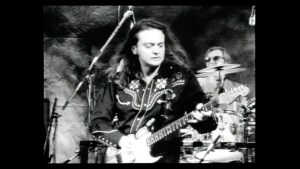
Gogo recorded his self-titled debut with producer Rick Parashar of Blind Melon, Pearl Jam, and Soundgarden fame, and the result is 12 consistently strong tracks brimming with Gogo’s virtuosic guitar work and husky, heartfelt vocals. Gogo wrote or cowrote every song but one, including “Deep End”, the disc’s first single and video.
“‘Deep End’ is the toughest song on the record,” he says. “It’s the heaviest track, so it’s definitely not the easiest song for the [Capitol Records] promotion department to push—especially since so much radio nowadays is so lame. But they’ve done a great job. It has been getting played. So if they can do that with that tune, I’m just hopin’ that the other ones are gonna be easier and easier.”
Gogo’s follow-up to “Deep End” is “Movin’ On”, a more straightforward tune that keeps good rockin’ company with such impressive butt-shakers as “Learned the Hard Way”, “The Slip”, and “Crawling Back to You”. Perhaps the most startling tune on the disc is Gogo’s Vaughan-style version of B.B. King’s “It’s My Own Fault”, a totally live, off-the-floor, one-take-wonder of scintillating slow blues in C.
“That song was Number 4 in Toronto recently,” says Gogo with a chuckle. “Isn’t that weird? I couldn’t believe it. We were driving to Toronto and we hear it, and then they go [in a smooth announcer’s voice]: ‘Yeah! And that’s David Gogo with “It’s My Own Fault”—Number 4 on the top 10 at 10.’ And I’m like, ‘Holy shit!’ ”
If more and more radio stations follow suit, the well-earned buzz on Gogo should know no bounds. When his power trio—including former Alannah Myles/Tom Cochrane drummer Jorn Anderson and ex-Persuaders bassist Todd Sacerty—plays the Town Pump next Saturday (April 23), it could be the last time we’ll see him in so small a venue.
But whether Gogo makes it to superstar status or not, you can rest assured that his deep love of the blues—and its most influential practitioners—will live on. He’s not about to downplay his debt to the inspiring guitar greats who’ve lit up his life.
Gogo doesn’t understand why many musicians refuse to acknowledge their influences. “The worst example recently has been the Counting Crows and this guy saying, ‘Oh, I’m really gettin’ sick of this Van Morrison comparison.’ I heard that you’re not even allowed to mention Van Morrison during interviews with that band. The guy’s writing a four-chord jangly pop song that says ‘sha-la-la-la-la’ and he doesn’t want to be compared to Van? Motherfucker should consider himself lucky to be put in the same sentence as Van Morrison as far as I’m concerned.
“You do want to do your own thing—which is why we’re not gonna sit there and be a Stevie Ray Vaughan tribute band. But during the course of the night we might do that Buddy Guy tune Stevie did, ‘Let Me Love You Baby’, as a tip of the hat. I mean, there’s no denying the influence.”
To hear the full audio of my 24-minute interview with David Gogo from 1994–and my two interviews with Stevie Ray Vaughan as well–subscribe to my Patreon page, where you can eavesdrop on over 500 of my uncut, one-on-one conversations with musicians since 1982.